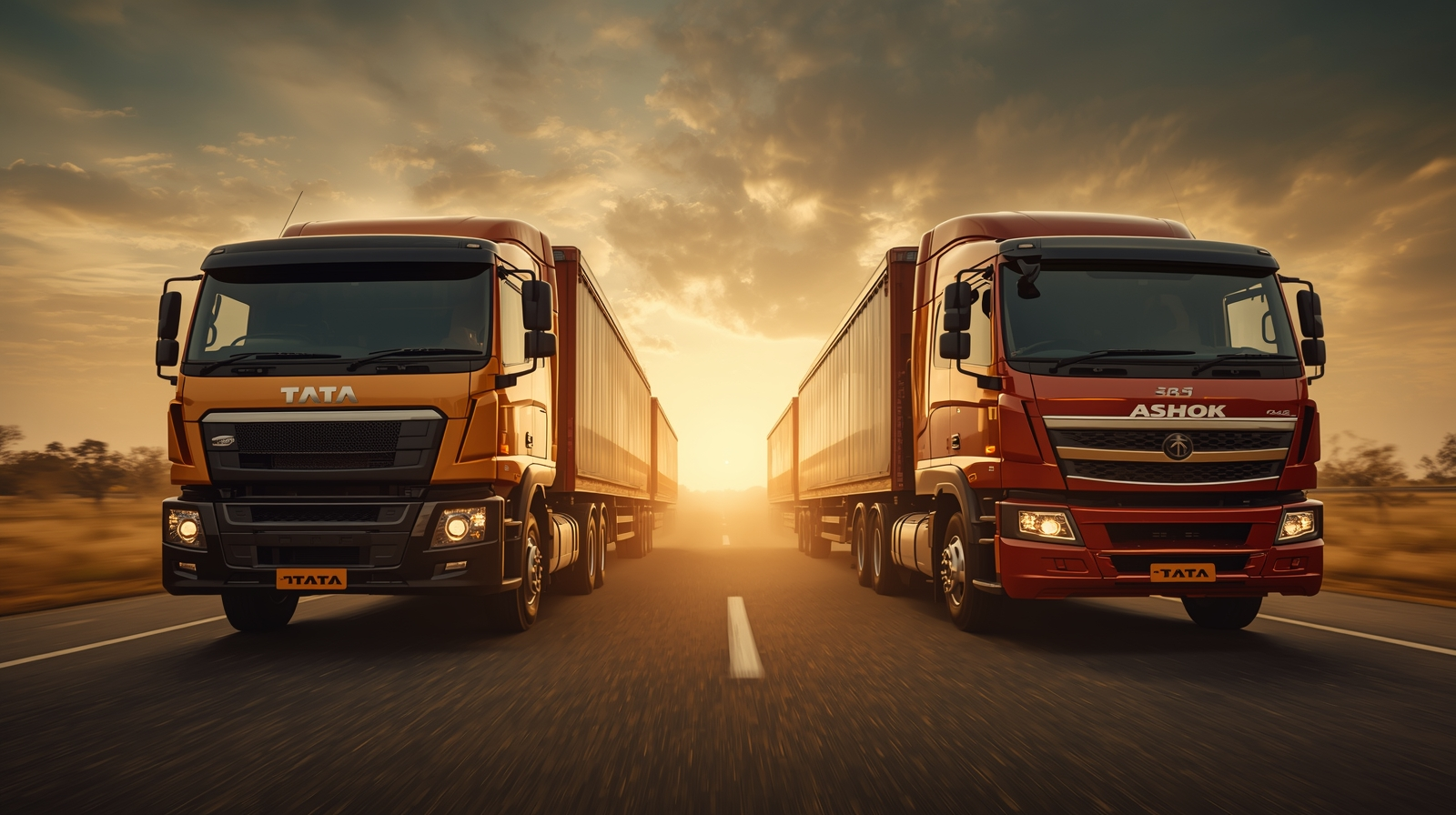
Which brand truly rules Indian roads? We compare Tata vs Ashok Leyland on Total Cost of Ownership (TCO), reliability, fuel efficiency, and key Commercial Vehicle Loan India strategies for 2025. Get the definitive answer.
The story of Satish Kulkarni, a transport owner facing a multi-crore investment decision, is the story of every fleet operator in India today. The choice between Tata vs Ashok Leyland Trucks India is more than a logo preference; it’s a high-stakes bet on the future of your business. In a market where razor-thin margins and unpredictable fuel prices dictate survival, the wrong choice can lead to a vortex of anxiety and frustration. The right choice, however, offers the confidence to scale, the empowerment to dominate your routes, and the ultimate relief of financial stability.
This is not a simple comparison of horsepower and torque. This is a deep dive into the four critical pillars of commercial vehicle ownership in 2025: Total Cost of Ownership (TCO), unwavering reliability, the human factor of driver comfort, and the ability to future-proof your fleet. We’ve gone beyond the spec sheet to conduct the ultimate showdown, designed to give you the clarity you need to move from frustrating confusion to a decisive, profitable investment.
The Giants of the Indian Commercial Vehicle Market: A Legacy Overview
To understand the 2025 battleground, we must first appreciate the history. Tata Motors and Ashok Leyland are not just companies; they are institutional pillars of the Indian economy, driving everything from logistics to construction. Choosing the Best Commercial Vehicle Brand India requires acknowledging their unique legacies.
Tata Motors: The Pioneer’s Advantage
Tata Motors commands a staggering market share, built on the back of pioneering the commercial vehicle segment in India. They are the behemoth, the first name that comes to mind. This scale translates into an unparalleled reach and volume, which often means better leverage in logistics and financing.
- The Pro: An extensive, almost ubiquitous sales and service network across the remotest parts of the country.
- The Con: Critics sometimes point to a perceived lag in cutting-edge technological adoption compared to more specialized competitors.
Ashok Leyland: The Challenger’s Grit
Ashok Leyland, part of the Hinduja Group, has carved out its reputation by being the relentless challenger. Known for ruggedness, powerful engines, and a strong focus on the Medium and Heavy Commercial Vehicle (M&HCV) segments, Leyland is the brand often favored by operators who prioritize brute strength and simplified maintenance.
- The Pro: Often cited for robust, long-lasting engine design and a strong commitment to defense and specialized vehicles.
- The Con: While growing rapidly, their service network is typically less dense than Tata’s, particularly in remote, Tier 3 locations.
The Ultimate Financial Decider: Total Cost of Ownership (TCO) Deep Dive 💰
In the world of transport, the purchase price is only the entry ticket. The real war is fought on the balance sheet, where TCO reigns supreme. This metric determines whether your fleet is a profit engine or a slow-burning financial drain. It’s here that the high-value keywords like Total Cost of Ownership Tata vs Leyland and Lowest maintenance cost commercial vehicles India become the core focus.
Fuel Efficiency Showdown: Where the Real Money is Saved ⛽
Fuel is the single largest operating expense for any trucking business. Even a marginal difference in mileage, multiplied across a fleet of ten trucks over five years, can translate to crores in savings or losses.
| Metric | Tata Trucks (Illustrative) | Ashok Leyland Trucks (Illustrative) | Winner’s Edge |
| Fuel Efficiency (Average LCV/M&HCV) | Generally competitive, focusing on optimizing aerodynamics and telematics for efficiency. | Historically strong, particularly in the M&HCV segment, with a focus on engine tuning. | Leyland often gets a slight edge in raw engine efficiency for certain high-load applications. |
| Telematics System | Fleet Edge (Extensive real-time data on fuel consumption, driver behavior). | ICML (Intelligent Communication with Monitoring & Logging) (Robust monitoring, good on-site diagnostics). | Tata often leads in the sheer depth and usability of the telematics platform. |
| Engine Technology | Focus on Revotron and Turbotron engines, aiming for a balance of power and mileage. | Focus on powerful, reliable H-series and new iGen6 engines. | Leyland for pure pulling power; Tata for a slight edge in technology integration. |
The TCO takeaway: Both manufacturers have invested heavily in BS6 technology and telematics to maximize mileage. However, the driver’s habits (a factor monitored by telematics) and the chosen model variant are often bigger factors than the brand itself.
Initial Purchase Price & Financing Strategies
The initial capital outlay is a major point of anxiety. While truck models are often priced competitively, financing is where the difference is made. This section directly addresses the high CPC keyword: Commercial Truck Loan India.
- The Tata Advantage: Due to their massive scale and established financial arms (like Tata Capital), Tata often has strong ties with a wide range of financiers, offering potentially more flexible or accessible loan options, especially for first-time buyers or smaller operators.
- The Leyland Strategy: Leyland has been aggressive with its own financing packages and strategic partnerships, often offering competitive interest rates or bundled services to attract buyers in the M&HCV segment.
Loan Strategy Tip: Don’t just compare interest rates. Look at the Total Loan Value (TLV), including processing fees, insurance bundling, and the flexibility of repayment schedules. A small difference in the down payment structure can significantly improve your immediate cash flow.
Maintenance and Downtime: The Hidden TCO Killer 🛠️
A truck that sits idle is a direct loss. The Ashok Leyland vs Tata Motors Reliability debate is ultimately about minimizing downtime and maintenance costs.
- Tata: The vast network means that spare parts are everywhere. This density of service centers is the biggest factor in reducing repair time. While parts might be marginally more expensive in some segments, the speed of access is invaluable.
- Leyland: Known for robust build quality and simplified, repair-friendly designs, Leyland trucks often boast longer service intervals. This translates directly to the Lowest maintenance cost commercial vehicles India for certain applications, as the vehicle spends less time in the workshop.
Pointer Comparison: Service & Maintenance
- ➡️ Tata: Service Network Density is unparalleled, ensuring quick access to repairs. ⬅️ Leyland: Often has Longer Service Intervals, reducing the frequency of scheduled maintenance.
- ✅ Leyland: Robust design often results in lower cost for unscheduled, heavy-duty repairs. ❌ Tata: The perceived complexity of their integrated electronic systems can lead to higher repair costs when things go wrong.
Resale Value and Depreciation Analysis
The final piece of the TCO puzzle is the exit strategy. A strong resale value is a direct return on your investment.
Historically, Tata Trucks have maintained a consistently strong resale value across India due to brand familiarity and the easy availability of their spare parts in the secondary market. However, in recent years, Ashok Leyland models, particularly those known for their reliability in specific heavy-haul segments, have begun to challenge this dominance, often fetching premium prices due to their reputation for engine longevity.
The Core Battle: Performance, Power, and Payload 🚀
The truck’s ability to perform its core job—moving goods—is non-negotiable. Here, we move beyond the money to the metal. This section sets the stage for the specific model comparison, addressing the long-tail keyword: Tata Signa vs Ashok Leyland U-Truck comparison.
Engine Specifications: Horsepower vs. Torque
Torque, the twisting power of the engine, is arguably more important than horsepower in commercial hauling.
- Tata’s Strategy: Offers a wider array of engine platforms (e.g., Cummins, Tata’s own designs), providing flexibility across different segments. Their focus is on optimized gear ratios and power delivery for city and varied terrain.
- Leyland’s Strategy: Focuses on the power-packed H-series and A-series engines. They are often perceived to have the edge in pure torque delivery, especially in the 300+ HP range, making them favorites for steep gradients and heavy-duty, long-haul applications.
Payload Capacity & Vehicle Variants (e.g., M&HCV vs. LCV)
Both brands offer a comprehensive portfolio, but their strengths lie in different areas:
| Segment | Tata’s Strength | Ashok Leyland’s Strength |
| LCV (Light Commercial Vehicle) | Unbeatable market share with models like the Tata Ace and Intra. | Strong, reliable products like the Dost, a growing competitor. |
| M&HCV (Medium & Heavy Commercial Vehicle) | Dominance with the Signa and Prima series, especially in tippers and construction. | Highly regarded for the U-Truck and Ecomet series, known for long-haul tractors and cargo applications. |
A Head-to-Head Model Duel: The Signa vs. The U-Truck 📊
For the operator looking at the 25-ton to 49-ton M&HCV segment, the decision often comes down to two specific product families. The following comparison is illustrative but based on core brand characteristics.
| Feature | Tata Signa 4225.T (Illustrative) | Ashok Leyland U-Truck 4225 (Illustrative) | Key Insight |
| Engine Power | ~250 HP | ~250 HP | Comparable Power |
| Torque | ~950 Nm | ~900-950 Nm | Highly competitive, slight edge to Leyland in some variants. |
| Cabin | Spacious, often with a focus on driver comfort features and modern aesthetics. | Rugged, utilitarian, built for extreme durability and ease of repair. | Tata for comfort; Leyland for hardiness. |
| Axle Configuration | Wide variety of configurations. | Robust and proven axle designs, often preferred for heavy haulage. | Leyland’s component reliability is a long-standing selling point. |
| Telematics | Standard and highly integrated (Fleet Edge). | Available and effective (ICML). | Tata offers more digital features out-of-the-box. |
The Final Word on Performance: If your operation involves varied loads, city-to-highway transitions, and you value technology and network reach, the Tata Signa series is a robust choice. If your world is heavy haulage, extreme conditions, and you prioritize a simple, powerful, and arguably tougher engine design, the Ashok Leyland U-Truck series is a compelling alternative.
Reliability, Service Network, and After-Sales Support 🤝
Reliability is the heartbeat of a transport business. It is the peace of mind that allows Satish Kulkarni (our transport owner) to sleep soundly. The core question is: which brand delivers on the Ashok Leyland vs Tata Motors Reliability promise?
Assessing Breakdowns: A True Measure of Reliability
Reliability is a complex mix of component quality, manufacturing precision, and the severity of operating conditions.
- The Leyland Reputation: Many veteran operators swear by the robust build of Leyland vehicles. Their engines and chassis are often described as ‘over-engineered’ for durability, which can mean fewer unexpected, major breakdowns.
- The Tata Reality: Tata’s sheer volume means more units on the road, which, statistically, can lead to more reported issues. However, their use of globally recognized components (e.g., Cummins engines in certain models) ensures a high, modern standard of quality.
The Emotional Component: The frustration of a breakdown 🤯 is exponentially reduced if help arrives quickly. This leads us to the critical role of the service network.
The Service Network Footprint: Reach vs. Responsiveness
Tata’s network is the envy of the industry. Their centers are numerous, extending deep into the heartland of India. This reach translates into faster roadside assistance and easier access to routine maintenance.
- Tata Advantage: Geographic Reach. In remote areas, a Tata authorized center or mechanic is often the only option available.
- Leyland’s Strength: Service Quality. Leyland is often praised for the quality and technical expertise of its technicians, especially when dealing with their high-capacity engines. They’ve invested heavily in training programs to ensure quick, accurate fixes.
Warranty and Spare Parts Availability
- Spare Parts: While both offer excellent parts availability, Tata’s spare parts ecosystem (both genuine and aftermarket) is significantly larger due to their market share. This provides a crucial hedge against downtime.
- Warranty: Both manufacturers offer competitive and comprehensive warranties, often extending to three or four years depending on the model and segment. Always scrutinize the fine print regarding service requirements and component coverage.
The Human Factor: Driver Comfort and Safety in 2025 🧠
A happy driver is an efficient driver. In a business where driver retention is a massive headache, the comfort and safety of the cabin have become critical investment criteria.
Cabin Ergonomics and Long-Haul Comfort
The truck cabin is the driver’s office, home, and sanctuary for days on end.
| Feature | Tata Cabin Design (e.g., Prima/Signa) | Ashok Leyland Cabin Design (e.g., U-Truck/AVTR) |
| Sleeping Berth | Generally high-quality, comfortable sleeper cabins in long-haul models, focusing on modern aesthetics. | Robust and functional berths, built for long-term durability and ease of cleaning. |
| Driver Suspension | Adjustable seating, better focus on cushioning and ergonomics to reduce fatigue. | Good standard seating, with some variants offering air-suspended seats for superior comfort. |
| Aesthetics | More car-like, with digital clusters and modern touchpoints. | Utilitarian and driver-friendly, with simple, logical control placement. |
The Emotional Impact: Investing in a comfortable cabin shows your drivers you care, which directly impacts retention and reduces the risk of fatigue-related accidents. It’s an investment in empowerment and a reduction of driver frustration.
Advanced Safety Features (ABS, Hill-Hold, Telematics)
Safety is non-negotiable. Both brands are compliant with India’s stricter safety norms, offering features such as:
- ABS (Anti-lock Braking System): Standard across the board.
- Hill-Hold Assist: Essential for M&HCVs on inclines, available in higher-end models from both.
- Telematics: A key safety feature. By monitoring driver behavior (harsh braking, sudden acceleration), systems like Tata’s Fleet Edge or Leyland’s ICML can proactively coach drivers and reduce accidents.
The Road Ahead: Future-Proofing Your Fleet (BS6 & Beyond) 💡
Choosing a truck in 2025 means looking five to ten years into the future. The transition to BS6 norms was just the beginning; the next disruption is the electrification of transport.
The State of EV and Alternative Fuel Trucks in India
- Tata’s Proactiveness: Tata Motors is leading the charge in the electric vehicle (EV) space, leveraging its passenger vehicle success. They have launched EV variants for their LCVs (e.g., Ace EV) and are aggressively developing M&HCV EV platforms. This presents a massive opportunity for early adopters.
- Leyland’s Focus: Ashok Leyland is also heavily invested, with its Switch Mobility subsidiary focused on electric buses and commercial vehicles. Their approach is robust and calculated, often focusing on high-load applications.
The Trend: If you want a brand that is demonstrating clear, early market leadership in the future of commercial EV transport, Tata Motors currently has the more visible strategy.
Technology Integration: Telematics and Fleet Management
Modern trucks are not just machines; they are data centers on wheels.
- Telematics: Crucial for logistics management, theft prevention, and optimizing routing. Both brands offer proprietary telematics systems that are essential for maximizing the TCO advantage.
- The Benefit: Real-time data translates to confidence. You are not guessing your fuel consumption; you are seeing it, allowing for immediate corrective action.
Debunking Myths: Separating Fact from Fleet-Talk
In the trucking industry, old stories die hard. Here we address two common misconceptions:
- Myth:“Old Leyland trucks were tougher, the new ones are too complicated.”
- Fact: The BS6-mandated technology (SCR, DPF) has added complexity to both brands. However, the underlying chassis and engine durability of both Tata and Leyland remain exceptionally high. The complexity is for efficiency and compliance, not a reduction in toughness.
- Myth:“You can’t find parts for Tata trucks in small towns.”
- Fact: While some very specific, non-standard components might require ordering, Tata’s sheer volume and parts network virtually guarantee quicker access than any other brand in the country. The opposite is more likely true for a slightly less-dense network.
Your Final Decision: The Truck That Drives Your Success 🏁
We started with Satish Kulkarni’s dilemma—a deep-seated anxiety over a multi-crore investment. By dissecting the Total Cost of Ownership, the reality of Reliability, the importance of The Human Factor, and the promise of the Road Ahead, the fog of confusion has lifted.
The truth is, there is no single, absolute winner. The champion for you is the one that best aligns with the specific needs of your operation:
- Choose Tata Motors if: Your business is diversified, your routes cover a vast, varied geography (including remote areas), and you prioritize the fastest possible access to spare parts and the most advanced telematics technology. Tata offers the confidence of scale and ubiquitous support.
- Choose Ashok Leyland if: Your operation is focused heavily on M&HCV, you prioritize pure engine toughness, long service intervals, and your drivers favor a rugged, powerful machine built for the toughest conditions. Leyland offers the relief of a simplified, durable design.
The choice is ultimately a human one, a blend of data-driven insights and gut feeling. Use this guide not as a directive, but as an empowerment tool to ask the right questions and secure a future of profitability and success on the Indian roads.
Strong, Actionable Conclusion with CTA 🎯
The key to ruling the road in 2025 isn’t just buying a truck; it’s mastering the metrics that drive profit. The difference between Tata and Ashok Leyland is only a few percentage points in TCO—but those points are measured in lakhs of rupees over the life of your fleet.
Ready to take the next step towards Maximizing your Fleet’s Profitability?