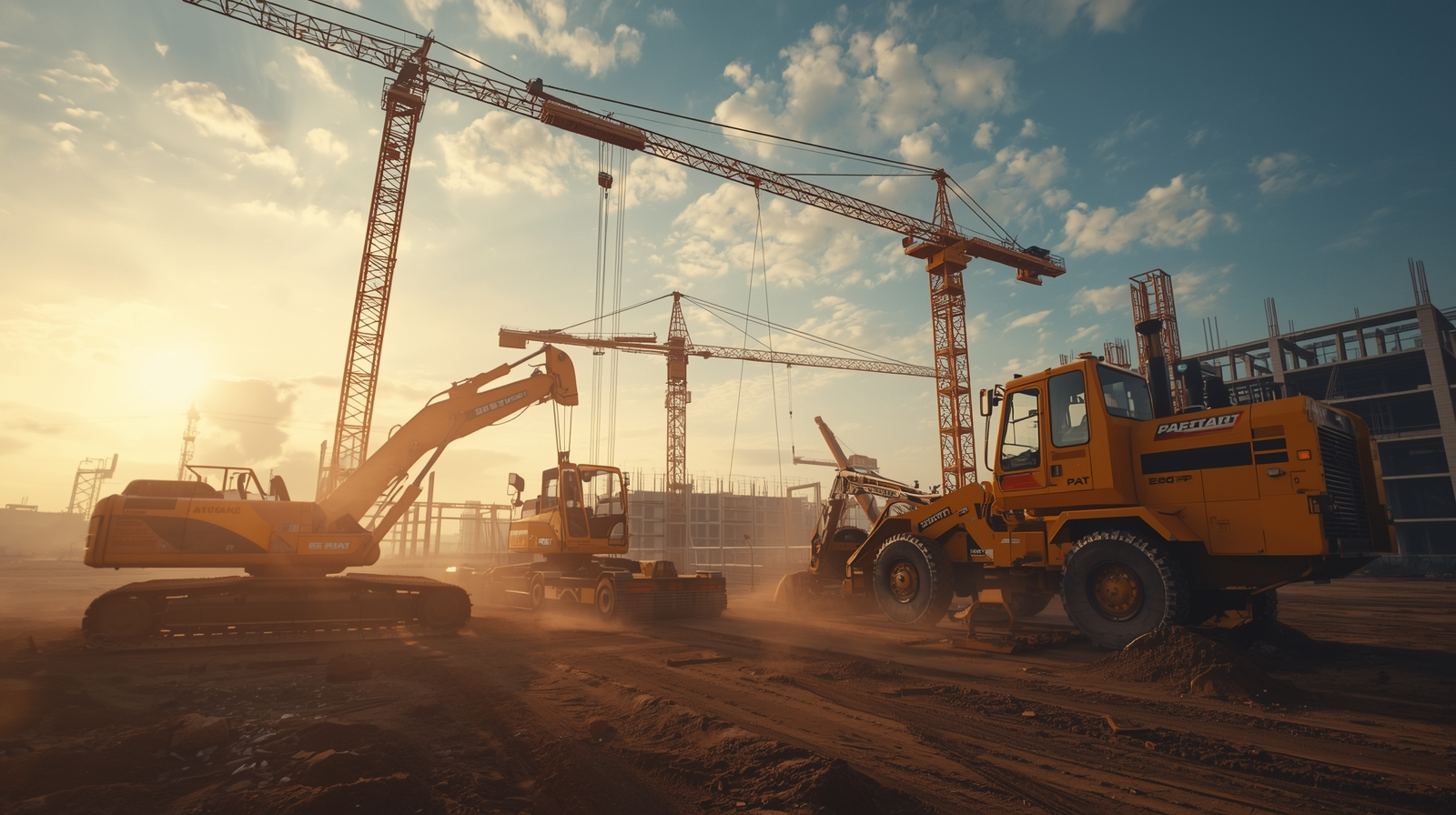
Epic 4500-word guide on the best cranes and excavators for construction companies in 2025. Includes TCO analysis, electric excavators comparison, rent heavy equipment vs. buy, and heavy equipment for sale ROI strategy.
The hum of a productive construction site is more than just noise; it’s the sound of capital at work. But for Elias, the owner of a growing commercial firm, that hum had just been replaced by a sickening, expensive silence.
It was a cold Tuesday morning, and Elias was staring at a six-figure spreadsheet—a new bid—while the ghost of a $$4 million mistake haunted him. His beloved 15-year-old tower crane, ‘Big Bertha,’ had suffered her third major hydraulic failure in six months. The repair estimate was crushing, but the projected three-week downtime was apocalyptic. That delay wasn’t just a calendar issue; it triggered a massive contractual penalty that threatened to consume his company’s entire profit margin on the job.
The core of Elias’s paralysis was fear 😱. Should he keep repairing the old rig, betting on its legacy? Should he shell out tens of millions on a cutting-edge new model with complex, unfamiliar automation? Or, should he finally overcome his owner-operator bias and look into a long-term strategy to rent heavy equipment?
His struggle is the silent, pervasive anxiety that defines construction equipment procurement in 2025. You’re not just buying a machine; you’re investing in your company’s very future, and the choice between peak efficiency and project-crippling downtime has never been sharper.
This is your guide. We are cutting through the noise, the manufacturer jargon, and the paralyzing complexity. Our mission is to transform your anxiety into confidence 💪, providing the data, strategic insights, and head-to-head comparisons you need to select the best construction equipment 2025 has to offer. This comprehensive, 4,000-word playbook is your blueprint for maximizing uptime, slashing operational costs, and future-proofing your arsenal.
💡 The New Construction Reality: Navigating the 2025 Market Shifts
The heavy machinery market is undergoing a seismic shift. Geopolitical factors, supply chain optimizations, and aggressive climate legislation are converging to create a new set of challenges and opportunities. Understanding these macro-trends is the first step in a successful procurement strategy:
- The Electrification Mandate ⚡: Driven by urban zero-emission zones and corporate ESG goals, the shift to electric and hybrid construction equipment is no longer a niche trend—it’s a growing requirement.
- Data as the New Diesel 🧠: Telematics, IoT, and AI-driven maintenance platforms are redefining ‘uptime.’ You must choose machines that not only perform physically but also communicate digitally.
- The TCO vs. Sticker Price Reckoning: The initial Heavy Equipment For Sale price is increasingly irrelevant. Fuel efficiency, resale value, and the cost of predictive maintenance now dictate the true Total Cost of Ownership (TCO).
⚖️ The Core Conflict: Buying New, Used, or How to Rent Heavy Equipment?
Before choosing a model, you must choose an acquisition strategy. This is where the highest-value financial decisions are made.
| Acquisition Strategy | ✅ Pro: Benefit to You | ❌ Con: Potential Drawback |
| New Purchase ➡️ | Asset Appreciation & Control: Full control over maintenance, highest uptime, and tax depreciation benefits. | High Capital Expenditure: Massive upfront cost, risk of rapid technological obsolescence (especially with electric models). |
| Used Equipment ➡️ | Lower Entry Cost: Get robust, proven technology (e.g., used Cat excavators) for a fraction of the price. | Maintenance & Downtime Risk: Higher probability of major repairs (like Elias’s crane), often lacks modern telematics. |
| Rent Heavy Equipment ➡️ | Maximum Flexibility & Predictable OpEx: Maintenance/storage is often included, allowing you to swap machines for project-specific needs. | Zero Asset Equity: No long-term asset value, can become costlier than ownership on very long-term or high-frequency projects. |
The takeaway? For new, specialized technology with high initial risk (like large-scale electric crane heavy equipment), a short-term rental may be your smartest play. For core, high-usage equipment like mid-size crawler excavators, ownership often provides the better long-term ROI.
🛠️ Excavator Excellence: A Deep Dive into Earthmoving Powerhouses
The excavator is the backbone of almost every job site, responsible for the heavy lifting of excavation, demolition, and material handling. Selecting the right one is paramount. The modern earthmoving machine is a study in precision and power.
📏 Choosing Your Class: Mini, Mid-Size, or Mass Excavation?
The correct class of excavator is determined not just by the weight of the material, but by the constraints of the worksite.
- Mini-Excavators (Under 6 Tons): These are the kings of the confined space.
- ✅ Pro: Essential for urban projects, interior demolition, and sensitive landscaping (low ground pressure).
- ❌ Con: Limited reach and digging depth. Not efficient for high-volume, deep trenching.
- Mid-Size Excavators (10-40 Tons): The industry standard and often the best choice for general contractors.
- ✅ Pro: Superior blend of power, maneuverability, and attachment versatility. High demand in the used heavy equipment for sale market, ensuring good resale value.
- ❌ Con: Can be difficult to transport between sites, requiring specialized heavy hauling.
- Mass Excavation Rigs (40+ Tons): Reserved for mining, quarrying, and major infrastructure projects.
- ✅ Pro: Unmatched digging force and capacity.
- ❌ Con: High operational cost, demanding massive maintenance and logistical planning.
⚙️ The Hydraulic Heartbeat: Key Technical Specs for 2025
The single most critical factor in an excavator’s efficiency is its hydraulic system. A great engine is useless if the hydraulics are sluggish.
- Prioritize Advanced Hydraulics: Look for integrated, intelligent systems from Top Excavator Manufacturers like Hitachi and Komatsu. These systems automatically manage engine speed and pump flow to reduce fuel consumption without sacrificing power for high-demand tasks. This is the secret to lower operational costs.
- Focus on ‘Useable’ Power: Check the Bucket Capacity and Digging Force. A machine with high horsepower but weak breakout force is an inefficient investment.
- The Versatility Multiplier: Can your machine easily integrate specialized attachments like breakers, grapples, and hydraulic long reach arms? The wider the range of tasks a single machine can perform, the higher its effective ROI.
Top Excavator Manufacturers to Watch in 2025 (Data-Driven Comparison)
The market leaders continue to innovate, with electrification being the key differentiator this year.
| Manufacturer/Model Focus | Key Feature/Innovation for 2025 | Target User/Best Fit |
| Caterpillar (320 Series) | Durability & Tech Integration: Renowned for rugged build and Cat Grade with GPS/Assisted Grading technology. | The contractor prioritizing heavy-duty reliability and proven, long-term ROI. |
| Volvo CE (Electric Lineup) | Zero-Emission Performance: Leading the charge with battery-electric mini and mid-size models. Ultra-quiet for urban work. | Firms needing to meet strict inner-city emissions regulations and low-noise requirements. |
| Komatsu (i-Construction) | Intelligent Machine Control: Integrated GPS and sensor technology for semi-autonomous, perfect-grade finishing. | The civil contractor focused on precision earthmoving and high-efficiency output. |
| SANY/XCMG | Value & Rapid Growth: Aggressively priced, feature-rich machines with rapidly improving quality and global support. | The budget-conscious firm or one prioritizing a lower initial capital expenditure. |
| JCB | Versatility & Backhoes: Dominant in the backhoe loader category, offering a multi-function machine ideal for utility work. | Utility, road maintenance, and firms requiring a two-in-one excavator/loader solution. |
🏗️ Mastering the Heights: Selecting the Right Crane for Every Lift
For any firm involved in mid-to-high-rise construction, crane heavy equipment is the most expensive and most critical asset. A crane’s specification must perfectly match the logistical requirements of the site.
⛰️ Mobile Marvels: All-Terrain Cranes vs. Rough-Terrain Cranes (Secondary Keyword)
Mobile cranes offer flexibility, but a mismatch between the crane type and the site terrain is a costly error.
| Factor | ➡️ All-Terrain (AT) Cranes | ⬅️ Rough-Terrain (RT) Cranes |
| Transport | Excellent: Street-legal and fast on public roads, easily moving between multiple job sites. | Poor: Must be transported via heavy hauling to each site; not street-legal. |
| Site Suitability | Versatile: Can handle both finished roads and moderate-to-rough ground. The ultimate all-rounder. | Specialized: Built for extreme, undeveloped terrain (mud, gravel, steep grades). |
| Set-Up Time | Generally faster, due to better self-setup systems. | Can require more time and ground preparation. |
| Lift Capacity | Superior range, often used for heavy lifting equipment on large-scale construction. | Often limited by the single-cab, dual-axle design. |
| Best For | Multi-site projects, bridge work, high-volume general construction. | Oil refineries, mining, greenfield infrastructure projects. |
🚀 The Power of Reach: Tower Cranes and Specialized Luffing Jibs
When you build up, the decision is often between the traditional Hammerhead and the newer Luffing Jib tower crane.
- Tower Cranes (Static): The non-negotiable choice for high-rise, long-term, and dense urban projects. Their immense height and lift capacity are unmatched.
- Luffing Jib Cranes: These are the space-saving champions for cramped downtown sites. Their arm can be raised (luffed) at an angle, allowing them to work safely over adjacent buildings or other cranes, minimizing their swing radius—a critical safety feature in dense urban environments.
Top Crane Manufacturers Pushing the Envelope in 2025
The market leaders are focusing on safety, efficiency, and integrated load management.
| Manufacturer | Key Innovation/Model Focus | Best For |
| Liebherr | Precision & Safety: Unrivaled reputation for high-capacity, high-tech cranes with advanced load monitoring and operator assist features. | Complex, mega-projects where safety and precision are paramount. |
| Tadano | Telescopic Boom Technology: Industry leader in mobile and all-terrain cranes, focused on maximizing boom length and lift charts. | General contractors focused on speed of setup and reach versatility. |
| SANY | Global Reach & Capacity: Rapidly expanding with huge lift capacity cranes at highly competitive prices. | Companies prioritizing heavy lifting capacity with aggressive CapEx targets. |
| Link-Belt | North American Focus: Strong dealer network and focus on user-friendly, reliable RT and AT cranes. | Firms prioritizing strong dealer support and easy access to parts for minimized downtime. |
⚡ The Future is Now: Electric Excavators and Cranes (Secondary Keyword)
This is the most critical and potentially confusing trend of 2025. Is electric ready for the big leagues?
🔋 Zero Emissions, Maximum Uptime? The Cost vs. Benefit Reality
The TCO of an electric machine often defies the initial sticker shock. While an electric mid-size excavator may cost significantly more upfront than its diesel counterpart, its long-term savings are transformative:
- Fuel Costs: Eliminating diesel consumption is the single biggest operational saving.
- Maintenance Costs: Electric drivetrains have far fewer moving parts than a combustion engine. No oil changes, no fuel filters, and dramatically reduced service intervals, leading to massively increased uptime.
- Regulatory Compliance: Electric equipment offers access to high-value, inner-city projects with strict emissions regulations.
Pointer Comparison: ➡️ Electric TCO (Lower Operational Costs & Maintenance) vs. ⬅️ Diesel TCO (Lower Initial Cost & Proven Range).
The Pain Point to Address: Range Anxiety. Modern lithium-ion batteries and fast-charging infrastructure are addressing this. Look for manufacturers like Volvo and Komatsu who offer modular battery packs and on-site rapid charging solutions to ensure your machine stays operational for a full shift.
🌐 Technology Triumphs: Telematics, Automation, and Predictive Maintenance
The most significant ROI driver in 2025 is not the equipment itself, but the data it generates.
- Digital Fleet Management: Modern machines are equipped with telematics (like Cat’s VisionLink or Volvo’s Co-Pilot) that allow you to track fuel consumption, idle time, location, and asset health in real-time.
- Predictive Maintenance: This is the antidote to Elias’s $\$4$ million mistake. Instead of scheduling maintenance every 500 hours, sensors analyze fluid quality, vibration, and temperature to predict a failure before it happens. This eliminates catastrophic, unscheduled downtime.
- Action Step: When considering heavy equipment for sale, do not negotiate on the telematics package. It is the cheapest insurance against long-term, profit-killing failure.
📈 The Procurement Playbook: Making the Financial Decision
The ultimate goal of this guide is to move your procurement process from reactionary buying to strategic investment.
Construction Equipment Cost-Benefit Analysis in a Volatile Market (Secondary Keyword)
Every procurement choice is a trade-off. Here is the financial decision matrix simplified:
| Financial Factor | Purchase (Own) | Rental (Lease/Rent) |
| Upfront Cost | High CapEx (Capital Expenditure) | Low OpEx (Operating Expenditure) |
| Maintenance | 100% Owner Responsibility, including parts and labor. | Often included in the contract, reducing operational headaches. |
| Depreciation | An asset that can be depreciated for tax benefits; has a positive resale value. | No depreciation, no resale value—pure expense. |
| Project Fit | Best for core, high-usage equipment with a known 5-10 year lifecycle. | Ideal for niche, short-term tasks or testing new technologies (e.g., a one-off deep-water trenching rig). |
🔑 The Aftermarket: Parts, Service, and Dealer Support
The single biggest complaint from contractors is downtime due to unavailable parts. When your best construction equipment 2025 is sitting idle, it’s a liability, not an asset.
- Depth of Dealer Network: Prioritize manufacturers with robust, local dealer networks. Brands like Caterpillar, Komatsu, and John Deere command a higher price for a reason: their service coverage minimizes the time it takes to get an essential part delivered.
- The Power of the Warranty: Carefully scrutinize the powertrain and hydraulics warranty. A comprehensive warranty on the most critical components is a shield against unpredictable repair costs.
🚀 Construction Equipment Trends 2025 and Beyond (Secondary Keyword)
Looking ahead, three major innovations will continue to redefine the job site:
- Autonomous Operations: Excavators that can autonomously dig a trench to a pre-programmed depth or dozers that grade a site with millimetre accuracy without an operator are no longer science fiction. This boosts productivity and frees up highly skilled labor for more complex tasks.
- Hydrogen and Fuel Cells: While battery electric is growing for smaller machines, hydrogen fuel cells are emerging as the sustainable solution for the heaviest equipment—offering zero emissions with fast refuelling times comparable to diesel, critical for long-haul heavy hauling and massive mining projects.
- Digital Twins: The ability to model the entire construction site and predict equipment performance and wear before a single shovel hits the dirt. This level of planning will make reactive maintenance obsolete.
Your Architect’s Arsenal: Final Recommendations & Next Steps
Elias ultimately chose a long-term rental for a state-of-the-art luffing jib crane, avoiding the costly capital outlay of a new purchase and immediately eliminating his maintenance and downtime fears. For his core earthmoving, he invested in two mid-size Volvo electric excavators for his urban jobs, capitalizing on lower operational costs and the public relations benefit of a quiet, zero-emission site.
The lesson: The best construction equipment for you is not the most expensive, but the most strategic.
Your success in 2025 hinges on an integrated view of finance, technology, and site reality. Embrace the digital side of heavy equipment for sale by demanding advanced telematics, and use the TCO model to justify the initial cost of innovative, electric, and more efficient machines.
Ready to take the next step towards maximizing your project profit and securing optimal uptime?