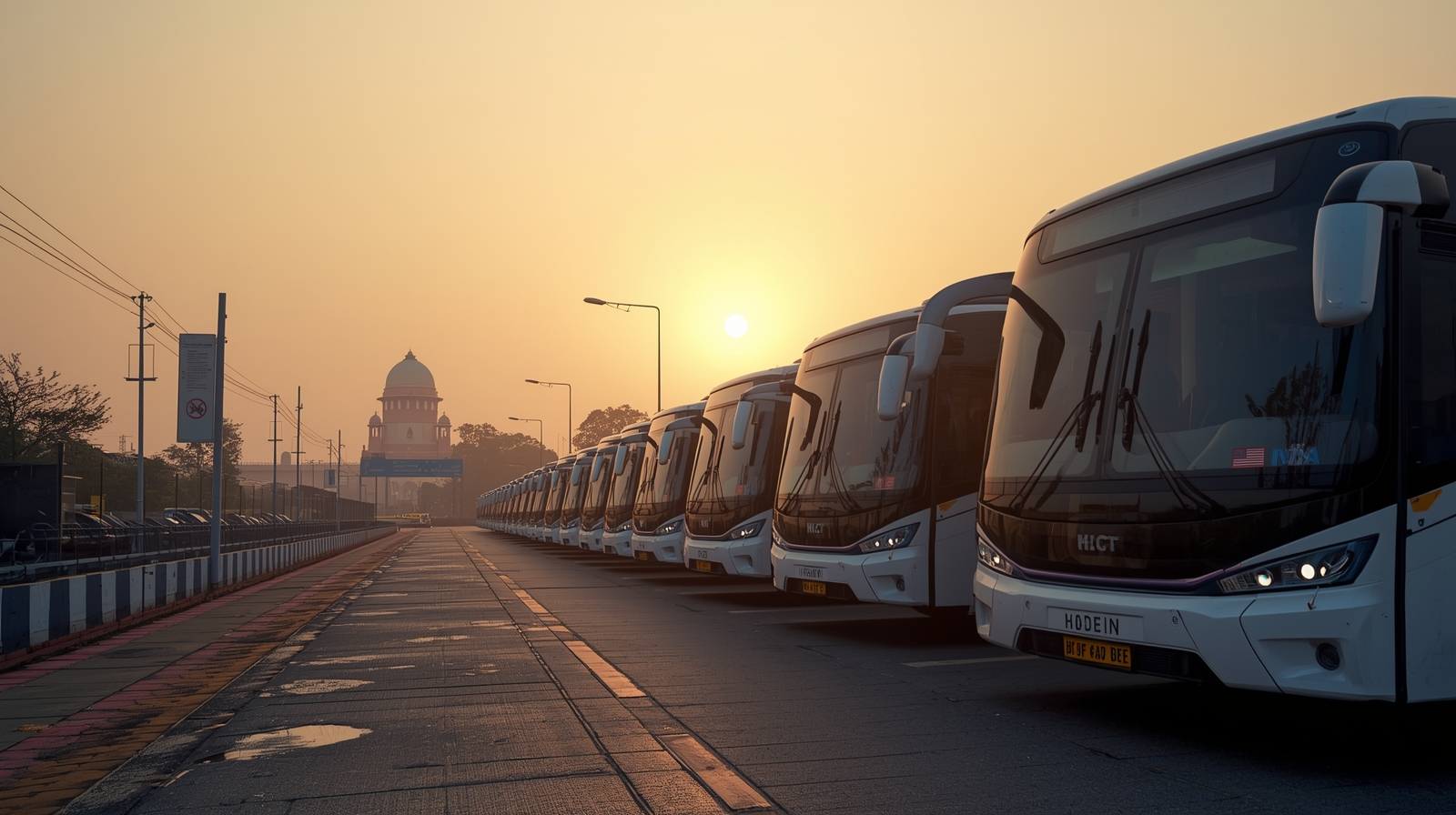
Decode the Upcoming India Bus Fleet Policies 2025. Expert analysis on e-Bus TCO, mandatory safety regulations, AC Cabin mandate, and Viability Gap Funding for private intercity operators.
Meet Ravi Kumar, a third-generation fleet owner. Ravi’s life is measured in kilometers and sleepless nights. His sleeper bus, ‘Shanti Devi,’ is his legacy, yet it’s also his greatest source of frustration and fear.
Ravi is caught in a vice. He sees the headlines about the tragic bus fires 🔥 and knows, deep down, that his aging diesel fleet, with its aftermarket electronics and worn-out parts, is a ticking liability. The new mandate for advanced safety systems is a welcome relief for passenger safety, but for his balance sheet, it’s a crippling expense.
He stares at the policy document: mandatory AC cabins, fire detection systems, electronic stability control. The cost to upgrade ‘Shanti Devi’ is unaffordable. The cost of a brand-new electric model is astronomical. The confusion about Intercity e-Bus Financing India and Viability Gap Funding is a knot in his stomach. He sees a future where he might be forced out of the business, watching the younger, tech-enabled operators glide past him in silent, new e-buses.
But there is hope ✨. This policy is also a promise: a promise of safer roads, cleaner air, and a modernized, profitable industry. The government isn’t just mandating change; it’s offering a lifeline. Ravi’s journey—the struggle to bridge the gap between old-world operations and new-world compliance—is the central challenge for every private operator in India today.
The Tectonic Shift: Why 2025 is the Policy ‘Year of Reckoning’ for Intercity Bus Fleets
The year 2025 marks the convergence of two critical government objectives: dramatically enhancing passenger safety and aggressively pursuing Net Zero emission targets. For the private sector, which operates over 90% of the long-haul routes, this means nothing less than a fundamental Fleet Modernization overhaul.
The core policy drive is moving fleets away from high-polluting, unsafe diesel coaches and toward cleaner, smarter vehicles.
Beyond Diesel: The Core Policy Pillars Driving Fleet Renewal
The new era of regulation is primarily being shaped by the evolution of existing schemes and the introduction of stricter mandates:
- Electric Mobility Push (PM e-Bus Sewa & PM E-Drive): While initially focused on city transport, the massive subsidy allocation is creating a manufacturing and financing ecosystem that will inevitably cascade into the intercity segment. The sheer volume of this initiative is the engine driving the India Bus Fleet Electrification Policy.
- Safety Standards Upgrade (AIS-XXX): The new Automotive Industry Standards (AIS) are moving from advisory recommendations to strict, enforceable mandates covering everything from braking to structural integrity.
- The BS6 Phase 2 Transition: This has already increased the sophistication and cost of diesel vehicles, making the leap to electric a financially and technically shorter jump in the long run.
The Safety Imperative: Mandatory Bus Safety Regulations 2025 India 🛡️
The policy landscape in 2025 is clear: passenger safety is non-negotiable. The new rules are designed to eliminate the most common causes of tragic accidents and fatalities, primarily fire and driver error. These Mandatory Bus Safety Regulations 2025 India require immediate attention and capital allocation.
The Comfort Revolution: Deconstructing the AC Cabin Mandate
One of the most talked-about changes is the mandate for air-conditioned cabins for drivers.
AC Cabin Mandate India Bus Cost: The Breakdown 📊
| Feature | Pre-2025 Standard (Non-AC) | Post-2025 Mandate (AC Cabin) | Impact on Operator |
| Driver Fatigue | High risk, especially in summer, leading to accidents. | Reduced risk; improved driver alertness and well-being. | ✅ Lower Accident Liability |
| Initial Cost | Marginal cost for basic cabin. | Estimated ₹1.5 Lakh – ₹2.5 Lakh increase per bus. | ❌ Higher Upfront CAPEX |
| Fuel/Energy Usage | None. | Small increase in diesel/battery consumption for the AC unit. | ❌ Higher Running Costs |
| Safety Compliance | Optional/Voluntary. | Mandatory from September 2025 (as per draft rules). | 🏆 Essential for Permit Renewal |
The AC Cabin Mandate India Bus Cost is a clear investment in human capital. By reducing driver fatigue, the government is tackling a leading cause of long-haul accidents. Fleet owners must budget for this retrofit or inclusion in all new purchases.
Life-Saving Tech: From Fire Detection to Advanced Driver Assistance Systems (ADAS)
The new rules mandate active and passive safety technologies that were once considered premium features.
- Fire Detection and Suppression (AIS-135): This is one of the most critical updates. The system must automatically detect and suppress fires in the engine and passenger compartments. No more empty fire extinguishers—this system is active and mandatory.
- Driver Drowsiness Systems: The push for high-tech Driver Drowsiness Systems and Lane Departure Warning (LDW) is a direct response to driver fatigue on long night routes. These ADAS features use sensors and AI to monitor driver behavior and warn them when focus lapses.
- Automatic Emergency Braking (AEB): While currently in the draft stage for buses built after a certain date, AEB technology represents the future. It automatically brakes the vehicle to prevent or mitigate a collision, acting faster than a human.
Pointer Comparison: Old Safety vs. New Mandate
- ➡️ Old: Manual, reactive fire extinguisher | ⬅️ New: Automatic, proactive AIS-135 Fire Detection & Suppression System.
- ➡️ Old: Driver relies on self-awareness/rest stops | ⬅️ New: Driver Drowsiness Systems that actively monitor fatigue and provide alerts.
- ➡️ Old: No standard structural integrity check | ⬅️ New: Stricter standards on structural build, especially for sleeper buses and exits.
The Electric Crossroads: Deciphering India Bus Fleet Electrification Policy ⚡
The most challenging, yet opportunity-rich, aspect of the new regime is the rapid electrification push. The government sees the intercity bus segment—which contributes an outsized 15% of road transport emissions—as a key target for its India Bus Fleet Electrification Policy.
TCO Tussle: Is the Electric Bus Total Cost of Ownership (TCO) Truly Viable for Long-Haul?
The biggest objection from operators like Ravi is the sticker shock: an electric bus costs 2x to 3x more than a diesel model. But this simple comparison ignores the Total Cost of Ownership (TCO). The TCO equation for the TCO Electric Bus India Intercity market is shifting dramatically.
| Factor | Diesel Bus (₹) | Electric Bus (₹) | Difference (Illustrative) |
| Acquisition Cost | 1.0 Crore | 2.5 – 3.0 Crore | ❌ Initial Cost is 2-3X |
| Fuel/Energy Cost | High, volatile (Diesel) | Low, stable (Electricity) | ✅ Up to 60-70% Lower/Km |
| Maintenance Cost | High (Engine, gearbox, fluids) | Very Low (Fewer moving parts) | ✅ Up to 80% Lower |
| Government Subsidy | Zero | Significant (e.g., under VGF/e-Bus schemes) | ✅ Reduces Effective CAPEX |
| Resale/Scrappage | Declining value, high pollution penalty | Higher residual value (linked to battery life/BaaS) | ✅ Future Asset Value |
| Life-Cycle Emissions | Very High (Pollution Penalty) | Zero Tailpipe Emission | 🏆 Compliance & Green Branding |
Conclusion: While the initial outlay is a heavy burden, the operational savings—the ‘fuel’ and ‘spares’ column—are so substantial that the TCO for high-utilization intercity routes can become favorable compared to diesel over the vehicle’s life, especially when coupled with subsidies.
Fueling the Future: Addressing the Intercity Charging Infrastructure Challenge
Range anxiety is a serious concern for long-haul routes. The current infrastructure is largely city-centric. The government’s strategy to overcome this involves:
- Corridor Development: Strategic investment and policy nudges for charging stations along key National Highways (NHs) connecting major metros (e.g., Delhi-Jaipur, Mumbai-Bengaluru).
- Private-Public Partnerships: Encouraging private energy companies and OEMs to set up fast-charging hubs at mandatory rest stops and major transport terminals.
- Battery-as-a-Service (BaaS) & Swapping: This is a game-changer. BaaS separates the cost of the battery (the most expensive component) from the bus itself, significantly lowering the Intercity e-Bus Financing India burden. For shorter intercity routes, automated battery swapping at key points is becoming a viable, fast alternative to charging.
Unlocking Capital: Intercity e-Bus Financing India and Subsidy Mechanisms 💰
The policy is only as good as its execution, and execution requires money. Fleet operators need clarity on accessing capital to meet the new mandates. This is where the Intercity e-Bus Financing India landscape is evolving fastest.
Bridging the Gap: Understanding Private Bus Operator Viability Gap Funding (VGF)
The single most critical mechanism for the private sector is the potential for Viability Gap Funding (VGF).
- What is VGF? It is a government grant provided to support projects that are economically justified but financially unviable due to high capital costs (like electric buses).
- The Private Sector Opportunity: While VGF has traditionally favored State Transport Undertakings (STUs), the fragmented private intercity market desperately needs this support. The upcoming policies are expected to feature tailored VGF schemes, potentially structured as per-kilometer subsidies or credit guarantees, designed to offset the initial high cost of e-buses for smaller, private players.
- Action for Operators: To qualify for Private Bus Operator Viability Gap Funding, you must prepare detailed project reports, demonstrating high vehicle utilization and a long-term commitment to the route. Compliance with the new safety and technical standards (H3) will be the key eligibility factor.
Leasing vs. Ownership: Strategic Financial Models for Fleet Transition
The decision between buying a bus outright and leasing one has never been more complex—or more strategic.
| Financial Model | ✅ Pro (Advantage) | ❌ Con (Disadvantage) |
| Outright Ownership | Full asset control, long-term collateral, benefit from full government subsidy. | Heavy upfront capital expenditure, exposure to maintenance costs, risk of technology obsolescence. |
| Leasing/BaaS | Low upfront CAPEX (improving cash flow), predictable monthly costs, shifting battery risk to the service provider. | No asset ownership, long-term commitment to a single provider, potential loss of full VGF benefit (depends on the scheme). |
Operational Overhaul: Navigating the Technical and Maintenance Challenges 🛠️
The new fleet, whether electric or modern diesel (BS6 Phase 2), demands a completely different operational mindset. The days of roadside tinkering are over.
The Digital Fleet: Telematics, Data Sharing, and Predictive Maintenance
Mandates are increasingly requiring Telematics and GPS tracking not just for passenger safety (real-time location) but for policy compliance.
- Data for Decision-Making: Policies are beginning to mandate data sharing on vehicle performance and battery health. This data is critical for Viability Gap Funding monitoring and for ensuring vehicles are being maintained.
- Predictive Maintenance: The vast electronics in a modern fleet (ADAS, BS6 engine control) allow for sophisticated diagnostics. Instead of fixing a breakdown, operators can use data to predict and prevent failures, significantly increasing uptime and profitability.
The Right to Repair Dilemma: Empowering Local Workshops
The transition to highly sophisticated BS6 diesel and electric components has created a Right to Repair challenge. Local, independent workshops, the backbone of India’s intercity bus maintenance, struggle to access proprietary diagnostic tools, software, and spare parts from Original Equipment Manufacturers (OEMs).
The upcoming policy discussions are focusing on:
- Standardized Interfaces: Mandating standardized hardware and software interfaces so that third-party tools can access essential diagnostics.
- Open Access to Manuals: Policy to ensure that repair manuals and necessary information are available to all, not just authorized OEM service centers.
This shift will ultimately reduce maintenance costs and downtime for operators, but it requires active policy enforcement against OEM resistance.
The Road Ahead: Future Trends, Market Opportunities, and the 2030 Vision 🚀
The new policies are not just a one-year event; they are the foundation of a new market structure aimed at a sustainable 2030 vision.
The Role of Alternate Fuels: LNG as a ‘Bridge’ Technology
Many operators are skeptical of full electrification today. For specific high-payload, long-range routes where charging infrastructure is non-existent, Liquefied Natural Gas (LNG) and Compressed Natural Gas (CNG) are emerging as viable “bridge” fuels. While not zero-emission, LNG buses offer a significant reduction in running costs and pollution compared to diesel, serving as a lower-risk investment before the Intercity e-Bus Financing India ecosystem matures fully.
Beyond Operators: Opportunities for OEMs, Financiers, and Service Providers
The policy mandates have created massive new commercial markets:
- OEMs & Tech Providers: A huge demand for new-age components like Driver Drowsiness Systems, AEB kits, and integrated telematics.
- Financiers: The rise of new leasing models and BaaS creates a massive appetite for new financial products, moving away from traditional vehicle loans.
- Infrastructure & Energy Companies: The need for charging hubs along NH corridors is a multi-billion dollar opportunity in land acquisition, power distribution, and fast-charging technology.
Summary: Your Fleet’s Policy Action Checklist for 2025
The time for passive waiting is over. Every operator must take immediate, strategic action:
- Review your Fleet: Audit all vehicles against the Mandatory Bus Safety Regulations 2025 India (AC Cabin, Fire Detection). Plan for upgrades or phasing out.
- Decipher the TCO: Run a detailed TCO Electric Bus India Intercity analysis for your highest-utilization routes. The savings on fuel and maintenance can justify the initial e-bus cost.
- Prepare for Finance: Research the upcoming schemes for Private Bus Operator Viability Gap Funding and Intercity e-Bus Financing India. Get your financial paperwork and project proposals ready now.
- Embrace Data: Start investing in basic telematics. The policy will eventually demand it, and the data will unlock predictive maintenance and efficiency savings.
Conclusion: Transforming Risk into the Route to Success
The Upcoming India Bus Fleet Policies 2025 may seem like a threat to the traditional way of business, but they are, in reality, a massive market correction designed to foster a safer, more sustainable, and ultimately, more profitable industry.
Ravi Kumar is no longer staring at his old bus with fear; he’s looking at the new policy as a roadmap. He understands that this is a race not against a competitor, but against obsolescence. He’s found a partner to help him navigate the complexities of Intercity e-Bus Financing India and is preparing his VGF application. His aspiration is now matched by a concrete action plan.
The future of intercity transport is electric, safe, and smart. Don’t let confusion or anxiety paralyze your business. Let this opportunity empower you.